


Why should we all celebrate February 21?
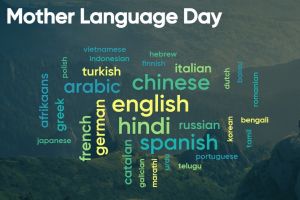
Every year on February 21, the world celebrates International Mother Language Day, which was established by UNESCO in 1999. The 2023 edition will focus on ‘multilingual education – a necessity to transform education’.
The celebration of this day has a twofold meaning: respect and preservation. On the one hand, it underlines the respect we all owe to our mother tongue and highlights the sacrifices and struggles that have been made in many parts of the world to preserve people’s right to speak, learn, study and teach their native language. On the other hand, it reminds us that this right is given equally to us and to others.
The transmission of a language as a mother tongue from parents to children is vital for its survival, because it creates new speakers and, thus, contributes substantially to its preservation and perpetuation. Second language learning has been highly important but it should not be at the expense of people’s mother tongues.
What are endangered languages?
The term “endangered” is usually associated with animals or plant species that are on the verge of extinction. But have you ever heard of “endangered languages”?
UNESCO states that any languages which are spoken by less than 10,000 people are considered endangered. There are dozens of languages which have only one remaining native speaker, whose death will signify the extinction of the language and, thus, the end of an era. Today, almost half of the – approximately – 7,000 languages spoken around the world* are in danger of extinction. According to the UNESCO Atlas of the World’s Languages in Danger, between 1950 and 2010, 230 languages were lost.
The question is, why are these languages becoming extinct?
Factors such as globalisation, migration, urbanisation, technological advances, even climate change, have led native speakers to either forget their mother tongues, or simply not continue speaking them. Particularly today, when certain languages, such as English and, to a lesser extent, Spanish and French, are widely imposed due to globalisation, it is important that we realise that the preservation of minority mother tongues and the right of each and every individual to be educated, to express themselves freely and to create in their mother tongue, is actually a statement of presence.
“When humanity loses a language, we also lose the potential for greater diversity in art, music, literature, and oral traditions,” says Bogre Udell, the founder of Wikitongues. And he goes on to say, “Would Cervantes have written the same stories had he been forced to write in a language other than Spanish? Would the music of Beyoncé be the same in a language other than English?”
The emphasis in recent years on preserving linguistic diversity is therefore the result of a change in the way we understand multilingualism and the essential role of languages in the development of human societies. Respect for linguistic diversity does not only promote the preservation of cultural diversity and the development of healthy dialogue and cooperation between societies, but it also makes a positive contribution to the economic, technological and scientific development of individuals, since the ability to express themselves in their mother tongue enables them to develop complex thoughts and meanings.
As Nelson Mandela once said, ‘If you talk to a man in a language he understands, that goes to his head. If you talk to him in his language, that goes to his heart’.
The celebration of the mother tongue is thus projected in this dual meaning of respect and preservation as an opportunity to remember, to talk and to dream, or else, to talk about the past, the present and the future of mother tongues. Language may just be a way to communicate with others, but mother language? Mother language connects us with our culture, with our roots, with our people and with our deepest feelings.
That’s why we should all celebrate February 21!
Happy International Mother Language Day 😊
by Maria G.
*Eberhard, David M., Gary F. Simons, and Charles D. Fennig (eds.). 2022. Ethnologue: Languages of the World. Twenty-fifth edition. Dallas, Texas: SIL International. Online version: http://www.ethnologue.com.